
This note was written on Tuesday, April 7th at 12:28AM. It was a cool 45f night, I had red wine with dinner. AGI, or something derivative, had not yet been achieved.
Disclaimer: I have hosted an Anthropic Claude event in Chicago. I am not paid, sponsored, or otherwise contractually related to Anthropic. This note is centered on Anthropic because I believe they represent the current peak of research available to everyday people to establish a perspective.
This note was made in an effort to distill the thoughts I have had percolating for some years, and also largely at the request of the people in my life who like me are still trying to figure out how to think about what’s happening. I included in this note links to reading materials that have helped me make sense of this changing world. I was finally pushed over the edge to write this note by Anthropic’s release of the “Mythos” Research Preview on Tuesday, April 7th.
Anthropic announced a research preview of “Mythos”, their latest generation of LLM in the Claude family - trained on an increasingly staggering amounts of compute. They have stated they will not release the model to the public for safety reasons. You should read the first few pages for yourself, but I will reference it handily throughout these pages.
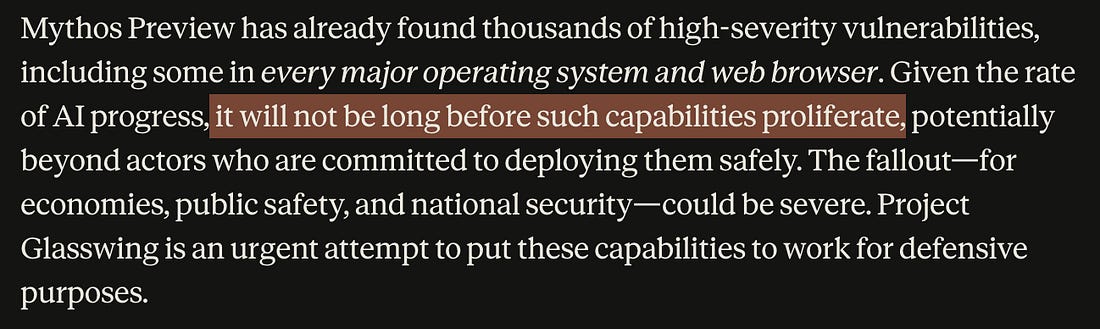
The reality of today is different than any day prior to it. That’s not hyperbole; let’s say the quiet part out loud - a private American company now holds more cyber offensive capabilities than any nation state on earth. This new model achieves benchmark leaps upwards of 25% over the leading SOTA competing models, including their own. We simply don’t have precedent anymore.
Across the announcement - in various phrasings, from multiple angles - they say one thing: we are afraid of the consequences of what we have built, and we believe the others coming behind us will be less careful. This is not avoidable.
This message has the potential to be frightening for many reasons. For me, it is frightening because it suggests there is no “secret sauce” to artificial intelligence. It means that, through sheer brute force and compute - we may unlock increasingly emergent capabilities of intelligence. Anthropic and I appear to share this fear, because it means if the scaling laws hold - if barrier to entry is only effort - then intelligence will be unevenly distributed in favor of those with the compute to brute-force it - leading to unchecked proliferation as a result.
Many will dismiss what Anthropic is saying in very plain language as marketing hype. They will ask you, or implore you, to question and doubt Anthropic’s motives in this, insisting the “hype bubble” will pop without your buy-in. I personally believe that framing is a mistake, and more importantly one that is a disservice to yourself and your control of your own future.
If instead you took the events playing out at face value, even just for a few minutes, it would lead you to ask a series of different, more difficult, questions.
Nukes, D&D, & ChatGPT
In November 2022 ChatGPT released, and like many others - I decided to consult one of the smartest people I know to help me understand it. The man I consulted was a PhD of mathematics and computer science who helped lead supercomputing research at a national laboratory. We met, as one does, playing Dungeons & Dragons.
His position was clear. LLMs were a mistake - not a wrong turn, but a trap. A consumer rabbit hole that would swallow billions in funding and years of serious research before the field admitted it had been chasing the wrong thing.
“They don’t think.” he said, “They pattern match.”
We’ve seen this situation before.
In 1940, the Allies discovered the secret to controlling nuclear fission: graphite rods. This discovery allowed scientists to maintain nuclear reaction in a sustained manner long enough to complete the final steps necessary to produce fuel for a nuclear bomb; something that Nazi Germany had discovered too - even sooner — but their graphite samples were unknowingly contaminated.
As a result, the Germans dismissed graphite as ineffective, in favor of an extraordinarily rare and difficult-to-manufacture alternative: heavy water. They were not wrong that heavy water could work, but the Allies would build and detonate a nuclear bomb before Germany ever achieved a sustained chain reaction. Both had the path to the nuclear bomb, now it was simply a matter of time - when and not if.

Now, you may pull back at the comparison of LLM development to that of a nuclear bomb. I will remind you again that today is different than yesterday. Today, a private company has access to a technology no-one else has, developed in a private lab, that is admittedly and plainly beyond that of any nation state capabilities. That technology they have told us, will remain secret, controlled, and shared only with “Allies.” for as long as they can. They fear it proliferating and the consequences when it does.
Critics of LLMs, like my friend, have been factually correct for years. The models do not think. They are, mechanically speaking, very large pattern matchers - trained on human text until statistical regularities in language become, for all practical purposes, indistinguishable from understanding.
But the question was never: “Do LLM functions constitute thinking?” The question was actually: “What could pattern matching do at a scale that we have never had access to before?”
Asking whether LLM functions constitute “thinking” is a philosophical question - it matters in the same way as asking “Did you build your nuclear bomb using graphite or heavy water?” The practical consequences are anything but.
What if it’s not a bubble?
Perhaps it’s unsurprising in retrospect that, at large, we have found ourselves incapable of taking Dario or Anthropic at face value.
That perhaps inevitably Anthropic’s repeated attempts to communicate plainly and publicly that they’re obsessed with the consequences of what’s happening, that they believe we’re not ready for the technology, or that they believe the economic shocks are seismic - were instead going to be read as marketing.
The cynical read - the convenient read - is that all of this is theater. That Anthropic's fear is a branding exercise. That the numbers are disconnected from reality and gravity will eventually reassert itself. The harder read is that none of this is theater - that Anthropic truly is afraid because they have looked at what they built and begun to understand something the rest of us haven’t caught up to yet.
They also don’t seem inclined to stop anytime soon.
To frame the stakes a different way, consider for a moment your faith in the existence of Jesus Christ - or better known as Pascal’s Wager.
Pascal’s Wager argued that by being a practicing Christian - or even a non-practicing one willing to acknowledge there might be a god - you effectively hedge your bets. If God is real and you believed, then you gain everything. If God isn’t real and you believed, you lose nothing. If God is real and you didn’t believe, you lose everything. The math is asymmetric, but the cost to take action is very low. Belief is a decision.
Anthropic meanwhile has made several things clear about their beliefs through their actions and words. They believe AI is the single greatest threat and opportunity to democracy moving forward, and as such they’ve committed billions of dollars and staked the existence of their company on it. They believe America’s relationship with this technology will define the next century, and as such they’re legally embattled with the Department of War over it. They believe there is a god, or something close to it, and to them he’s locked in the machine. For them, the stakes are clearly existential.
In the case of AGI for you and I, the math is similar. Choosing to believe this is a bubble, stakes-wise, is choosing not to participate or take action when real world consequences are at stake. Belief or more appropriately, disbelief, is an action you can choose and begin to take.
A country of geniuses in a datacenter
If you asked a random person what the world's economy is based on, many might mistakenly name gold. More cynical types will name oil. A humorous bunch might say coffee. The persnickety bunch will gesture toward energy et al. I would argue it is none of these.
I would not be the first to argue that Intelligence is the bedrock pricing function of the world economy. The cost of labor is, in effect, the premium pricing on intelligence.
Anthropic understood this when they were raising money. Their Series C pitch was unambiguous:
‘These models could begin to automate large portions of the economy. We believe that companies that train the best 2025/26 models will be too far ahead for anyone to catch up in subsequent cycles.’
What you pay a lawyer for is not their time. It is their judgment. What you pay an engineer for is not their keystrokes. It is their ability to model and solve. Artificial intelligence has the same deflationary pressure on human intelligence that artificial diamonds have on natural ones. The underlying value proposition does not disappear; but the scarcity does.
What happens in a world where genius is common? Where the thing that was rare, the ability to reason carefully through hard problems, becomes abundant and cheap? We don’t have an answer to this, but Mythos is our first real glimpse of this phenomenon and what the answer may look like. Not because it is smarter than the smartest human. But because it is smart enough, widely available enough, and served cheaply enough to interrupt a bedrock of human civilization and its problems - laziness.
Security vulnerabilities were considered rare because of how difficult they are to find. At scale, like say diamonds or uranium, they are plentiful. Mythos found thousands of those security vulnerabilities across every major operating system and browser in a matter of weeks, some of which had unknowingly existed for 25 years, not just because it is smarter than human researchers, but because their scarcity was primarily a problem of scale, not intelligence, and artificial intelligence solves problems of a human scale the same way it exposes them.
Artificial intelligences effect is not only deflationary in pricing. It reduces the barrier to entry for problems long regarded as unsolved because of their sheer scale or tedious nature. The things we didn’t do yesterday, because they weren’t worth doing at human labor costs (laziness), suddenly become worth doing today.
The question is no longer should we solve most problems but rather will we? The answer to this is not “priced in” as they say.
The Practical Consequences Are Anything But
Mythos appears to be the first class of model trained, at scale, on Blackwell architecture - a GPU released by NVIDIA in late 2024.
If that is true, we can anticipate there will be next-gen Vera-Rubin-class models beginning their training in ~6 months and releasing in mid-2027 at the earliest.
If GPU’s are to LLMs, as enriched uranium is to a nuclear bomb, then Vera-Rubin is to the production of these models the same as moving from Heavy Water to Graphite. It’s not a question of if you reach nuclear fission - it’s when.
The release of Mythos further suggests, as stated at the beginning, that pre-training isn’t as saturated as believed and reinforcement-learning continuously works. These components are the sustained reaction required to enrich the models to critical state - intelligence if you will. The implications are staggering and they go far beyond just LLMs.
We will be forced to reckon with this as a country, and more globally as a people. I’m not here to even attempt to reconcile with that.
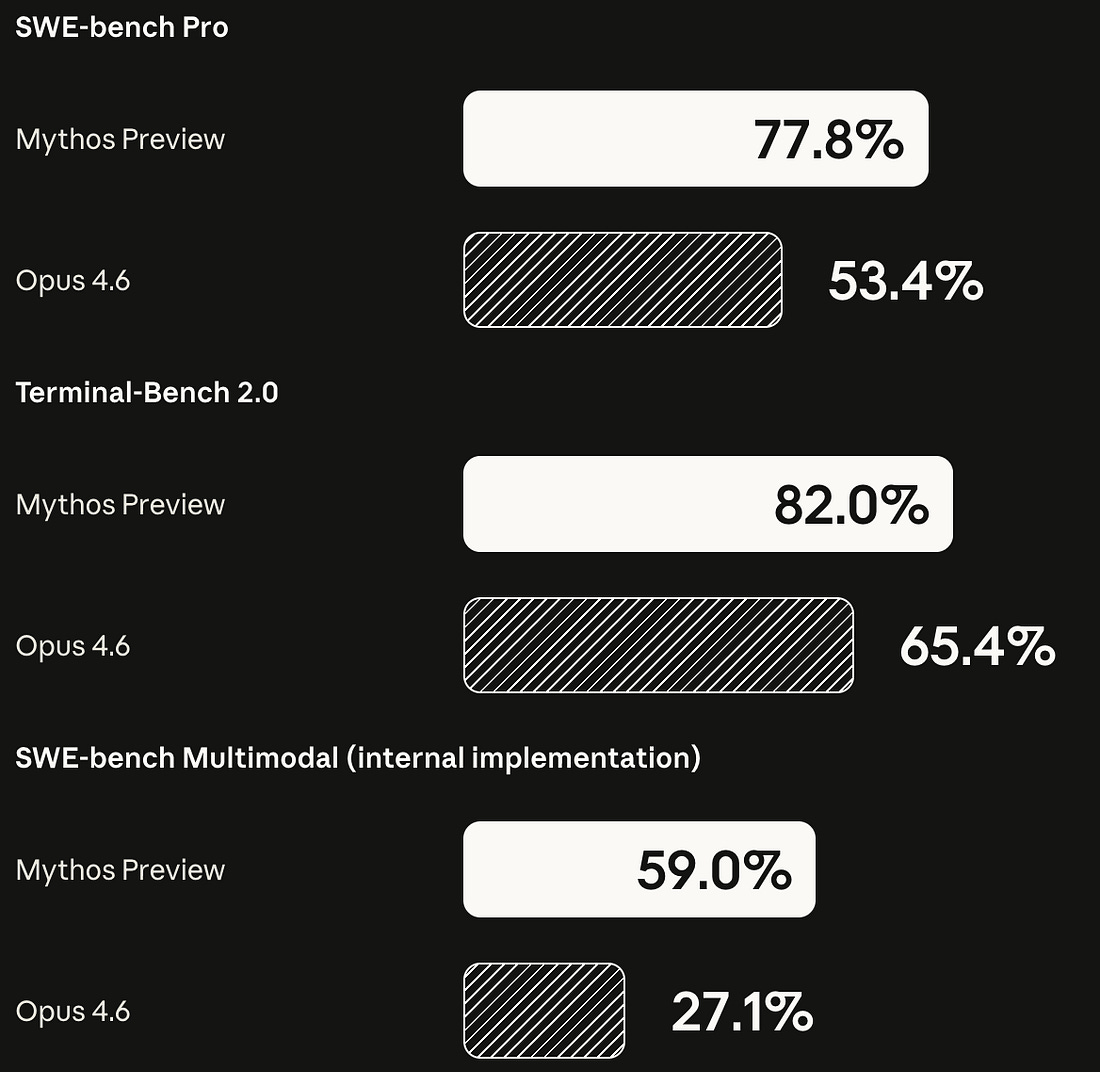
As Anthropic indicated so directly in the Mythos release today, things may begin to move very quickly now. “But we’re already moving so fast” you might say - and you’re right.
However, as of today, I am personally convinced we are experiencing the “elbow” of the curve. The question I’m asking myself now is no longer whether the curve exists, but rather how wide and steep the curve may end up being - and where is my place in it?
It’s why I wrote this. So that I, and perhaps you too, can participate in the conversation of “What happens next?” from a position beyond “wait and see if it’s real”. It starts with acknowledging that today is different than yesterday.
On days like today, which are increasingly common, I find myself thinking of my friend who dismissed LLMs as the rabbit hole. “they don’t think, they pattern match.” He spoke those words definitively and gravely.
He now works at NVIDIA research.
-
CS